
As a trade with associated craft skills in the construction industry; plastering has an especially long running thread; connecting heritage and tradition, with contemporary ways of finishing building’s internal and external surfaces ready for decoration by others, or possibly to be left with a natural finish; as with clay internal plasters, pebble dashed renders, or where the artist is involved: fresco work into curing lime plaster.
The craft operatives who apply hand lay up finishes are parts of this thread, or links in a chain, from the artist, to the guilder, the solid plasterer, the fibrous plasterer, the ornamental fixers and finishers, the contemporary dry wall system applicators, and the patch plasterers; dealing with small damaged or substandard finishes which must be made good or upgraded, prior to completion of the works. The job description ‘patch plasterer’ may not sound all that inspiring for a nascent competent plasterer looking to improve skill sets and establish themself as an artisan; as the term patch has a few negative connotations: chief among them; that the operative sent out is returning to put right damage caused by third parties, or worse; brought back to rectify sub-standard work; by bringing it up to the mark.
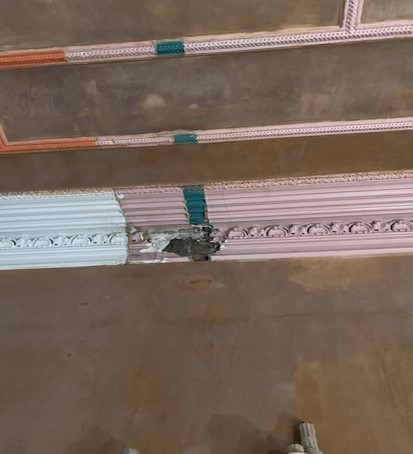
There are also problems that can be anticipated, perhaps for experienced plasterers who have been sent out to put something right that past experience tells them could be problematic. For example; the image shows damage caused to plasterwork in a period property where perhaps a partition or such like has been removed. An instruction on an email could simply read “attend site and make good small section of plasterwork in the ceiling to wall intersection.”
The image shown has a damaged cornice which is quite large, with perhaps ten plain members, but more difficult to match; an ornamental enrichment on the ceiling member, and in the concave mid point cove of the cornice. Firstly a repeat has to be identified in the decorative enrichment pattern, then from this; a mould made to produce a matching cast, then an experienced craftsperson has to bed, fix, and make good the work with on site hand lay up techniques and appropriate finishing small tools.
On this job Whitechapel Art Plaster Co Ltd were called in to assess the work then give two options for rectifying the problem. The template, match, fix and make good, or to match component parts only; and supply the rest of the materials needed for completing the ornamental plaster remediation. In this instance the solid plasterers on site were experienced in fixing matched components so Whitechapel Art Plaster Co Ltd attended site, took any sections, templates squeezes or measurements required to produce the matching plaster sections and after our bench plasterers in the shop completed the matching work returned to site to deliver them to be fitted by others.
Whitechapel Art Plaster Co Ltd specialise in matching plain decorative plaster members, ornamental enrichments and curved work, which needs to meet delivery requirements; in terms of quality of matched finish, so the finished work is to all intents and purposes invisible as a repair when decoration has been applied and also in terms of working with time scale regarding the programme.
Repeat clients for this kind of patch plaster problem solving, is an important part of our ordered book; both for the work it brings into us, and for the repeat clients with whom we very often form long standing mutually beneficial working relationships. For customers just looking to solve their own problems and which may be a one off job we usually deal with the full package; survey, assessment, report with recommendations, and quoted works: through to the supply and fix along with any after sales service required.